How to Sharpen Kitchen Knives at Home: A Beginner’s Step-by-Step Guide
It sounds counterintuitive, but a dull knife is actually much more dangerous to use than a razor-sharp one. Over my years of exploring culinary tools and practical home maintenance, I’ve seen countless amateur cooks struggle to slice a simple tomato because their blade requires excessive downward force—drastically increasing the risk of the knife slipping. If you’ve been wondering how to sharpen kitchen knives at home effectively without ruining your expensive blades or spending a fortune on professional services, you are in exactly the right place.
Why You Need to Sharpen Your Knives Regularly
Knives, just like any other piece of specialized equipment in your home, require routine maintenance. Just as you might regularly remove rust from cast iron to keep it in peak cooking condition, sharpening and honing a blade ensures safety, precision, and longevity. When a knife is sharp, the blade effortlessly bites into the skin of an onion or pepper. When it’s dull, it slides off.
Use-Case Scenario: Imagine trying to finely dice an onion with a dull chef’s knife. Instead of slicing through the layers, the knife crushes them, releasing excess sulfurous compounds into the air, causing your eyes to sting horribly. A sharp knife causes far less cell damage to the food, completely changing your prep experience.
Sharpening vs. Honing: What’s the Difference?
Before diving into sharpening methods, it is absolutely essential to distinguish between sharpening and honing. People constantly confuse the two.
- Honing (The Steel Rod): That long metal rod that came with your knife block does not actually sharpen your knife. On a microscopic level, a knife’s edge bends slightly out of alignment with regular use. Honing simply pushes that bent microscopic edge back into the center. You should hone your knife before almost every major cooking session.
- Sharpening: Sharpening physically removes metal from the blade to create a brand new, v-shaped edge. Because it strips away material, you should only legitimately sharpen your knives about 2 to 4 times a year depending on how heavily you cook.
The Best Methods to Sharpen Knives at Home
1. The Whetstone (The Professional’s Choice)
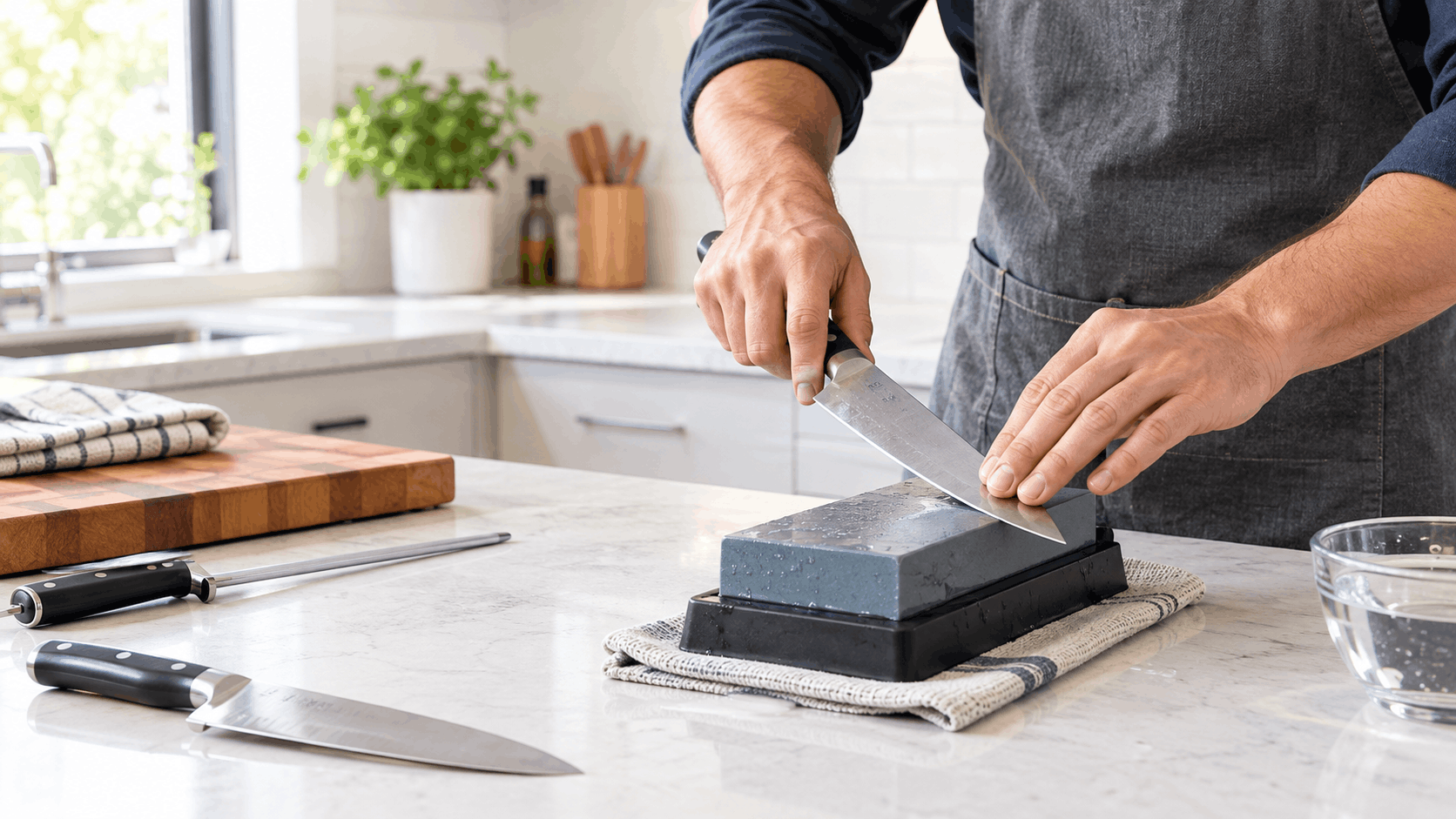
Using a whetstone (or water stone) is universally considered the best way to sharpen knives. While the learning curve is slightly steeper, it removes the least amount of metal, produces the sharpest edge, and gives you total control.
The Step-by-Step Process:
- Soak the Stone: Submerge your whetstone in water for about 10-15 minutes until bubbles stop surfacing. (Note: Diamond stones or oil stones do not require water soaking).
- Find Your Angle: Standard Western chef’s knives should be held at roughly a 20-degree angle to the stone. Japanese knives require a tighter 15-degree angle. If you’re unsure what 20 degrees looks like, place two stacked pennies under the spine of the blade.
- The Stroke: Starting with the coarse grit side of the stone (usually 400-1000 grit) facing up, place the heel of the knife at the bottom of the stone. Push the blade forward and across the stone in a sweeping motion toward the tip, maintaining that exact 20-degree angle. Apply moderate pressure on the forward stroke, and relax pressure when pulling back.
- Check for the Burr: After 10-15 strokes, feel the opposite side of the edge with your thumb (pulling away from the blade edge, never along it). You should feel a tiny, rough lip of metal called a “burr.” Once you feel this, flip the knife and repeat on the other side.
- Refine the Edge: Flip the stone to the finer grit side (typically 3000-6000 grit) to polish the edge and remove the burr, using lighter strokes.
2. The Pull-Through Sharpener (The Beginner’s Choice)
If the whetstone feels too intimidating, manual pull-through sharpeners are highly cost-effective and completely foolproof. Most come with two or three slots—Coarse, Fine, and Polish.
To use one, set it firmly on the counter, place the heel of the blade into the coarse slot, and pull the knife straight back toward your body with light, even pressure. Do this 3 to 5 times. Move to the fine slot and repeat.
Experience-Based Warning: Never push the knife back and forth in a pull-through sharpener. Only pull in one direction. Furthermore, avoid using these on delicate, single-bevel Japanese knives, as the V-shaped tungsten carbide inserts will completely ruin their unique blade geometry.
3. How to Sharpen a Knife Without a Sharpener (Coffee Mug Hack)
We’ve all been situated in a vacation rental with terribly dull knives and no sharpening equipment in sight. If you need a quick edge, turn a ceramic coffee mug or bowl upside down on the counter. The unglazed ring at the bottom of the ceramic acts exactly like a high-grit sharpening stone.
Simply sweep the blade along the unglazed ceramic ring at a 20-degree angle as you would a whetstone. It won’t give you a master-craftsman edge, but it will rapidly turn a dangerously dull knife into a highly usable tool.
How to Test Your Knife’s Sharpness
How do you know when you’ve succeeded? The classic “paper test” is still the gold standard. Hold a piece of standard printer paper vertically with one hand. With the other hand, attempt to slice straight down through it. A sharp knife will glide through the paper smoothly; a dull knife will catch or tear the paper. Much like mastering how to properly process and restore kitchen ingredients, achieving this perfect paper slice gives immense satisfaction to home cooks.
Frequently Asked Questions (FAQs)
1. How often should I sharpen my kitchen knives?
For standard home cooks, you only need to truly sharpen your knives 2 to 4 times a year. However, you should use a honing rod to straighten the blade edge before almost every major use.
2. Is it bad to sharpen knives on electric sharpeners?
Electric sharpeners are fast, but they consume far more metal from your blade than manual methods like whetstones. While they are acceptable for cheaper utility knives, avoid running expensive Japanese or heirloom chef’s knives through an electric sharpener.
3. Can a dull knife actually be more dangerous?
Yes. A dull knife requires you to use significantly more downward physical force to cut through food. This dramatically increases the chances of the blade slipping off the food’s surface and catching your fingers instead.
4. At what angle should I sharpen a standard chef’s knife?
Most Western-style (European or American) kitchen knives should be sharpened at a 20-degree angle. Japanese-style knifes are generally thinner and should be sharpened at a 15-degree angle to maintain their delicate slice.
5. What is the difference between honing and sharpening?
Sharpening physically shaves away metal from the blade to create a new, sharp V-shaped edge. Honing uses a straight metal or ceramic rod to simply push an existing microscopic edge back into the center when it gets slightly bent from use.
6. Do serrated knives need to be sharpened?
Yes, though much less frequently than straight blades. However, serrated bread knives require a specialized tapered sharpening rod to individually file the interior curves of the serrations. A standard whetstone will ruin a serrated edge.
7. Can I ruin a knife on a whetstone?
It’s very difficult to permanently ruin a knife on a whetstone. The worst-case scenario is that you use the wrong angle and dull it further, or you create an uneven bevel. Both mistakes can be fixed by simply going back to the stone with proper technique.
8. Can I clean my knife in the dishwasher after sharpening?
Never put a good kitchen knife in the dishwasher. The intense heat, prolonged moisture, and highly abrasive detergents will rapidly dull your freshly sharpened edge and will warp or crack wooden handles over time.